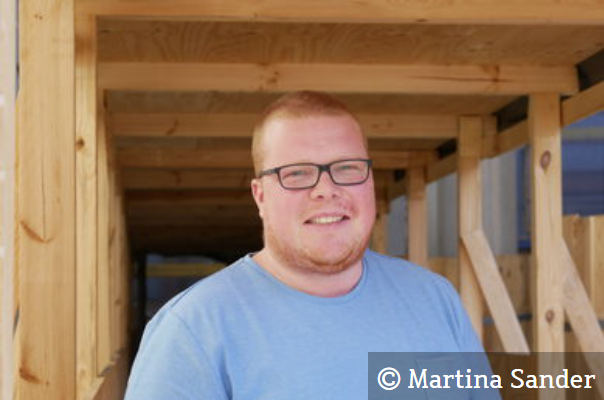

Hi there
my name is Christian and I am a quantitative sociologist at the WZB research unit on Skill Formation and Labor Markets, where I work in the EU Horizon Europe project “Mapping inequalities through the life course” (Mapineq). Until 2024, I have been a junior researcher at the WZB Health and Social Inequality research group and a doctoral candidate at the Department of Political and Social Sciences of the Freie Universität Berlin. Prior to joining WZB, I earned a B.A. in Political Sciences and Economics from the University of Tübingen and a M.Sc. in Economics from the University of Konstanz.
My research examines the spatial dimension of the causes, patterns, and consequences of social inequalities. A first strand of my work deals with environmental inequalities and climate change. I study how environmental goods (e.g., urban green spaces and leisure facilities) and bads (e.g., air pollution, noise) are distributed across urban neighborhoods, why these inequalities differ between cities, and how they affect the health of different social groups. Increasingly, this work also addresses exposure to extreme heat and its consequences for health, cognitive functioning, and school success. A second strand is concerned with residential segregation and gentrification, both as outcomes in their own right and as drivers of the environmental inequalities described above. A third strand moves from the neighborhood to the municipal and regional level and looks at how spatial and spatio-temporal contexts shape educational opportunities and labor market outcomes.
In published work, I have examined how neighborhood structure relates to environmental quality in German cities (Urban Studies, 2024), how residential segregation, gentrification, and other city-level factors explain why neighborhood environmental inequalities vary across cities (Urban Studies, 2026), and how unequal access to home air conditioning translates into educational inequalities (Energy Research & Social Science, 2026). Ongoing projects continue along these lines. Using a survey experiment, we study ethnic differences in neighborhood preferences and what they imply for environmental inequality. Other projects ask whether the health effects of residential environmental quality differ by socioeconomic status and origin, and how ethnic differences in environmental quality relate to educational outcomes in Italy. Together with colleagues, I also examine why tertiary-educated individuals concentrate in the centers of German cities and how different ways of measuring the city center affect findings in urban inequality research. In two further projects that originated within the Mapineq project, we study the short- and longer-term effects of conditions at labor market entry across countries (working paper) and whether proximity to universities and housing costs shape young adults’ study choices.
Education
- Ph.D in Sociology (summa cum laude), Freie Universität Berlin, 2024
- M.Sc. Economics, University of Konstanz, 2019
- B.A. Political Science and Economics, Eberhard Karls University Tübingen, 2016
Positions
2024- Research Fellow in the Research Unit on Skill Formation and Labor Markets, WZB
2019-2023 Research Fellow in the Research Group on Health and Social Inequalities, WZB
2019-2021 Research Assistant at the Cluster of Excellence “The Politics of Inequality”, University of Konstanz
2018 Graduate Trainee in the Directorate General for Innovation and Technology, European Parliament
Teaching
2026 Trends and determinants of educational inequality (Seminar, MA), Freie Universität Berlin
2025 Introduction to causal research designs (Seminar, MA), Freie Universität Berlin
2024 Mapping inequalities across the Life Course (Seminar, MA), Freie Universität Berlin
2022 Inequality and Social Stratification (Seminar, MA), Freie Universität Berlin
You can find my full CV here